

05 Oct 2026
Beyond tools: How teachers can build AI literacy
AI has become part of everyday life, whether students have been taught how to evaluate it critically or not. While much of the conversation focuses on what AI can do, access to AI tools alone does not develop AI literacy. Teachers are increasingly being asked to help students understand when AI should be trusted, questioned, challenged or not used at all.
In our latest webinar, our Expert Teachers in Residence Phil, Andy and Dino share classroom examples, practical scenarios and professional reflections that bring the 4 interconnected domains of the Organisation for Economic Co-operation and Development (OECD) AI Literacy Framework to life.
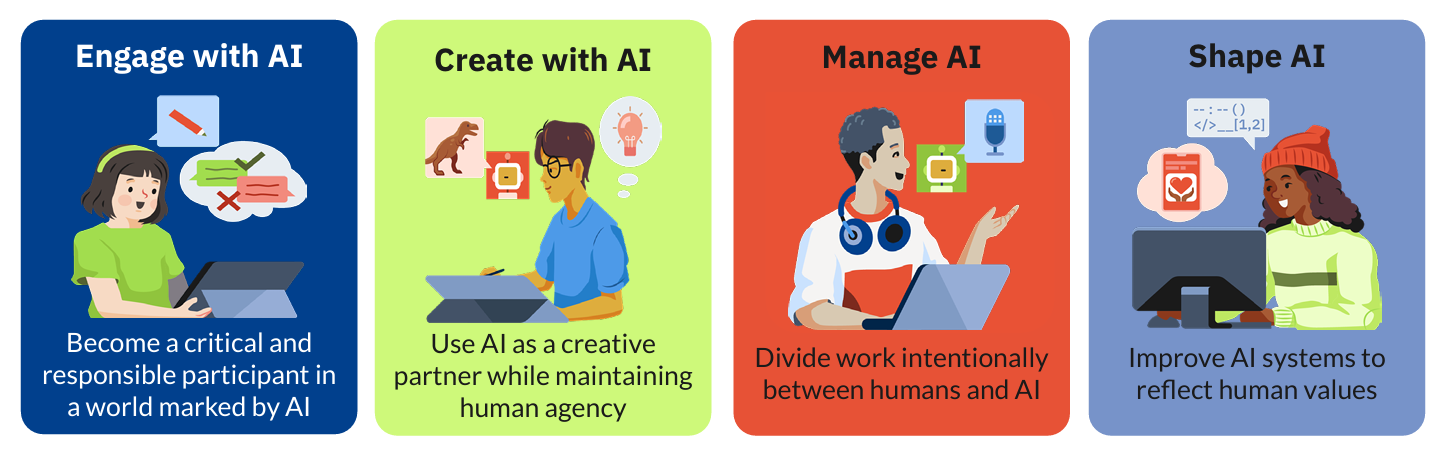
The domains of the AILit Framework. Source: OECD & European Union (2026), Empowering learners for the age of AI: An AI literacy framework for primary and secondary education, p. 8. CC BY 4.0.
Watch the webinar
Length: 59:16

Download

Engage critically, not automatically
Phil Thomas has spent much of his teaching career exploring technology-enhanced learning and digital innovation.
Phil says AI literacy starts with engaging critically with AI. Engagement should go beyond knowing how to write a good prompt. He challenged educators to evaluate example AI responses for inaccuracies, generalisations, narrow assumptions and excessive certainty. Similar exercises can be used with students in the classroom to teach them the skills, knowledge and dispositions to effectively evaluate AI outputs.
Create with AI while maintaining agency
Andy Ding has taught students across secondary, VCE and special school settings to use AI for creativity.
For Andy, creating with AI means responsibly leveraging a co-creator while keeping your voice, originality and authenticity. In his Year 9 English assignment based on Lois Lowry’s dystopian novel The Giver, students used AI-generated ideas and arguments as a starting point for writing a podcast script from the antagonist’s point of view. They could use AI to analyse and discuss but then had to use creative and critical thinking, alongside ethical considerations, to assess outputs. AI supported the creative process, but students ultimately remained responsible for the outcome, transparently recording their selection and justification process along the way.
Manage what stays deliberately human
The Manage domain focuses on deliberately deciding where AI is used and what remains human. Phil used a head/heart/hands framework and asked educators to decide how these could be applied to determine in a range of scenarios what could be delegated partially or wholly to AI and what should remain human. For example, generating draft questions? AI can assist with this as it is largely administrative, and draft questions require a human perform a review and edit. Writing communications to send home? This activity should never use AI as it sits squarely in the relational.
The question is not whether AI can perform a task, but whether delegating that task is appropriate based on whether it is cognitive, relational or administrative. While the examples were for teachers, Phil said they could easily be re-imagined for a student learning context.
Shape AI towards societal benefit
Dino Cevolatti lectured in human computer interface and multimedia systems design at Monash University before becoming a science and physics secondary teacher.
The Shape domain expands the conversation into investigating, evaluating, designing and improving AI systems. Dino explored how this can be relevant in an education setting. He used the hypothetical example of a school preparing to introduce an AI-supported learning platform and examined the school’s decision-making process through the Australian Framework for Generative Artificial Intelligence in Schools.
Dino encouraged educators to question not only outputs, but also the values and power relationships that produce them, helping ensure AI systems reflect human values and societal benefit.